
Introduction
If you just bought a radio, you probably need a Baofeng UV-5R antenna upgrade immediately. Why? Because the stock antenna that came in the box is basically a ‘dummy load’… It prevents your radio from burning out, but it’s terrible for actually transmitting signals.
To get the most out of your radio, you need an upgrade. But which one should you choose?
In the world of ham radio and prepping, there are two undisputed kings of budget antennas: the Nagoya NA-771 and the Abbree Tactical (Foldable).
I’ve tested both in urban environments and dense forests. Here is my honest breakdown to help you decide which Baofeng UV-5R antenna upgrade is right for your comms setup.
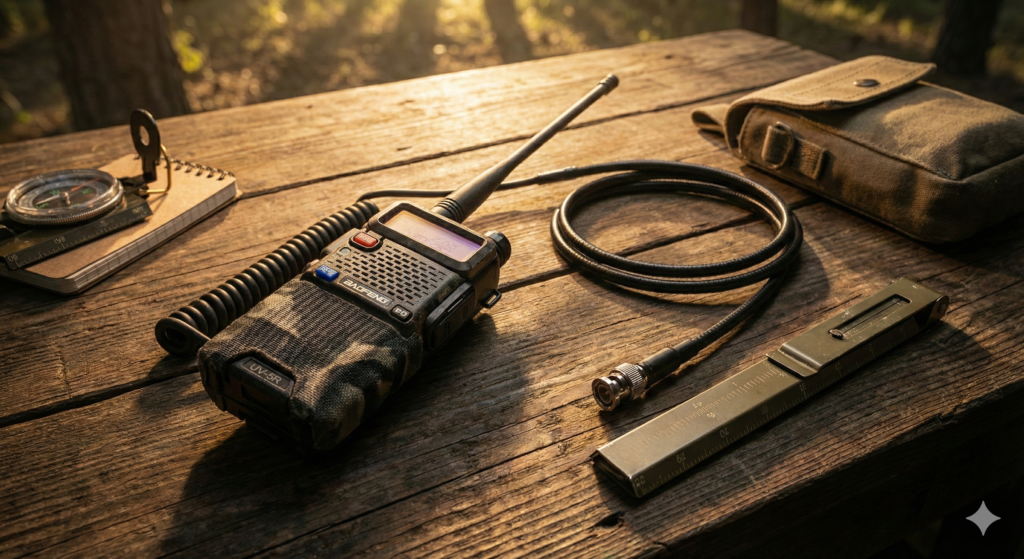
The Contender: Nagoya NA-771 (The Reliable Classic)
The Nagoya NA-771 is widely considered the “gold standard” for Baofeng radios. It is a 15.6-inch whip antenna that offers a significant improvement over the stock “rubber ducky.”
Pros:
- Durability: It is flexible but sturdy. You can bend it, and it snaps right back.
- Form Factor: It’s thin and light. It doesn’t make the radio feel top-heavy.
- Performance: Consistently adds 20-30% more range compared to the stock antenna. It opens up repeaters that were previously static.
Cons:
- Length: At almost 16 inches, it can be annoying to carry on a belt or in a pocket. It tends to poke you in the ribs.
- Counterfeits: This is the most faked antenna on Amazon. (Tip: Only buy from trusted sellers like BTECH).
Best For: General use, hiking, and everyday carry (EDC) in a backpack.
The Challenger: Abbree Tactical Antenna (The Beast)
If you’ve seen military movies or tactical gear reviews, you’ve seen the Abbree. It looks like a folding tape measure wrapped in rubber. It comes in various lengths (18.8″, 25″, 42″), but the 18.8-inch version is the sweet spot for the UV-5R.
Pros:
- Range: In my tests, the Abbree slightly outperformed the Nagoya in dense foliage and urban canyons.
- Portability: This is its superpower. You can fold it in half or thirds and secure it with a velcro strap. When you need to transmit, you “deploy” it like a tactical weapon.
- Cool Factor: Let’s be honest, it looks professional and tactical.
Cons:
- Weight: It is heavier and thicker than the Nagoya.
- Wind Resistance: Because it’s flat and wide, it catches the wind.
- Fragility: The folding mechanism (tape measure steel) can kink or break if you abuse it too much over years.
Best For: Search and Rescue, tactical vests (plate carriers), and maximizing range in difficult terrain.
Comparison Table: Nagoya NA-771 vs. Abbree
| Feature | Nagoya NA-771 | Abbree Tactical (18.8″) |
| Type | Flexible Whip | Foldable Tape Measure |
| Length | 15.6 inches | 18.8 inches (Foldable) |
| Durability | High | Medium |
| Portability | Low (Always long) | High (Folds up) |
| Range Boost | +30% | +35% |
| Best Use | Hiking / Backpack | Tactical Vest / Max Range |
WARNING: Beware of Fakes! ⚠️
The market is flooded with counterfeit antennas that perform worse than your stock rubber ducky.
How to spot a fake Nagoya:
- ** The Bag:** Real Nagoyas come in a distinct green bag with rounded corners. Fakes often come in cheap orange or clear plastic.
- ** The Logo:** The font on the base should be sharp and silver, not dull white.
- ** The Connector:** Ensure you buy the SMA-Female version for the UV-5R. (SMA-Male will not fit).
❓ FAQ: Common Questions About Baofeng Antennas
Does a longer antenna really increase range?
Yes, generally speaking. A longer antenna (like the 15.6″ Nagoya) has a larger radiating element, which allows it to transmit and receive signals more efficiently than the stubby stock antenna. However, length isn’t everything—tuning matters too.
Will these antennas fit other Baofeng models?
Yes! The Baofeng UV-5R uses an SMA-Female connector. This is the same connector used on the Baofeng UV-82, BF-F8HP, and UV-9R. Both the Nagoya NA-771 and Abbree Tactical will fit these radios perfectly.
Why is my reception still bad after the upgrade?
If you upgraded your antenna but still hear static, check your Squelch (SQL) setting. On a UV-5R, the default squelch is often too low or too high. Set it to 1 or 2. Also, remember that VHF/UHF relies on “line of sight.” If you are in a valley or inside a concrete basement, even the best antenna won’t help much.
🛠️ How to Install Your New Antenna Safely
It might seem obvious, but many beginners break their radio’s connector by doing this wrong.
- Turn off the radio. Never remove an antenna while the radio is transmitting.
- Unscrew the stock antenna by turning it counter-clockwise.
- Check the connector. Ensure the golden pin is on the radio side, and the hole is on the antenna side (SMA-Female).
- Screw in the new antenna gently. Do not overtighten! Stop as soon as you feel resistance. Overtightening can crack the solder joints inside the radio.
- Use the rubber washer. Most Nagoya antennas come with a small rubber spacer. Use it to fill the gap between the antenna and the radio body to prevent water from getting in.
Final Verdict: Which One Should You Buy?
If you can only buy one, here is my advice:
- Get the Nagoya NA-771 if you want a “set it and forget it” solution. It’s durable, reliable, and perfect for throwing in a backpack. It is the best all-rounder.
- Get the Abbree Tactical if you wear your radio on a chest rig or need to squeeze every last meter of range out of your device. The ability to fold it away when not in use is a game-changer for tactical gear setups.
My recommendation? Buy both. Keep the Nagoya on the radio and keep the folded Abbree in your go-bag as a high-gain backup.
(Disclaimer: Always ensure you are transmitting on legal frequencies for your license class.)