
Introduction
A mesh network is only useful if it’s running when the grid goes down. In a real-world emergency, you can’t rely on wall outlets to keep your communication nodes alive.
To build a truly resilient network, you need a Meshtastic solar power node.
So, you have successfully flashed your device (if not, read our Firmware Guide first). Now, you want to put it on a roof or a tree to get maximum range. But a standard battery only lasts about 24 hours. You can’t climb a tree every day to recharge it.
In this guide, I will show you exactly how to build a “set it and forget it” off-grid node that runs 24/7, even in cloudy weather.
☀️ The 4 Core Components You Need
To build a reliable Meshtastic solar power node, you need to balance energy generation (solar) with energy storage (battery). Here is the shopping list:
1. The LoRa Board
We recommend the Heltec V3 or the RAK WisBlock.
- Heltec V3: Cheap and powerful, but consumes more power.
- RAK WisBlock: The gold standard for solar. It uses extremely low power (uA sleep mode), making it perfect for small panels.
2. The Solar Panel (5V – 6V)
Don’t go too big. A massive panel acts like a sail in the wind.
- For RAK boards: A small 2W to 5W panel is enough.
- For Heltec/ESP32: You need at least 6W to 10W. The ESP32 chip is “hungry” and needs more juice to stay alive through the night.
- Tip: Always choose Monocrystalline panels. They work much better on cloudy days than the cheaper Polycrystalline ones.
3. The Battery (18650 Li-Ion)
The 18650 cell is the king of DIY batteries. It’s the same type used in old Tesla cars and power tools.
- Capacity: Look for real 3000mAh – 3400mAh cells (Panasonic, LG, Samsung).
- Warning: If you see a battery labeled “9000mAh,” it is a fake. Do not buy it.
- Configuration: For a solar node, I recommend a 2P configuration (two batteries in parallel). This gives you ~6000mAh, which can power a Heltec board for 3-4 days of total darkness.
4. The Charge Controller (BMS)
You cannot just connect a solar panel to a battery. You will overcharge it and cause a fire.
Most LoRa boards have a basic charging chip built-in.
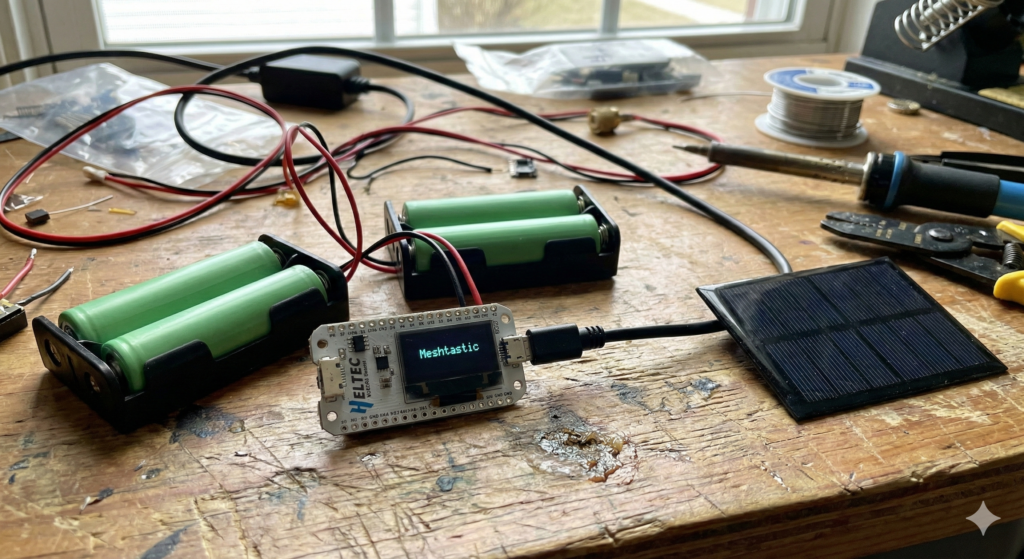
- Easiest Method: Plug the battery into the board’s battery connector (JST 1.25), and plug the solar panel (via USB) into the board’s USB-C port.
- Pro Method: Use a TP4056 charging module. It regulates the voltage perfectly and protects your battery from draining too low.
❓ FAQ: Your Questions Answered
Will this work in winter or on cloudy days?
Yes, but only if you plan correctly. A 10W panel will still generate some power on a cloudy day, usually enough to keep a low-power node alive. The key is the battery. A large 6000mAh battery pack can keep a Heltec board running for nearly 4 days with zero sun.
Can I just use a regular USB power bank instead of raw 18650s?
Generally, no. Most standard power banks have an “auto-shutoff” feature. Because Meshtastic boards use very little power, the power bank thinks nothing is connected and turns itself off to save energy. Your node will die after 30 minutes. You need “raw” batteries or a specialized “always-on” power bank.
How high should I mount the node?
Height is everything for LoRa. “Line of Sight” is key. A node on a rooftop (30 feet up) will perform 10x better than a node sitting on a window sill on the first floor. Get it as high as possible.
📊 Comparison: Heltec V3 vs. RAK WisBlock for Solar
When choosing components for your Meshtastic solar power node, the most critical decision is the board type.
Choosing the right board is the biggest decision. Here is a quick breakdown:
| Feature | Heltec V3 / WiFi LoRa 32 | RAK WisBlock (RAK4631) |
| Price | Affordable ($20-$25) | Expensive ($40-$60+) |
| Power Consumption | High (Needs big panel) | Ultra-Low (Best for solar) |
| Ease of Use | Beginner Friendly | Modular / Advanced |
| Built-in Screen | Yes (OLED) | No (Usually separate) |
| Best For… | Testing & Home Nodes | Permanent Mountain Nodes |
My advice: Start with a Heltec V3 because it’s cheap. If you need a serious node on a mountain top later, upgrade to RAK.
🛠️ Step-by-Step Build Guide
Step 1: Prepare the Enclosure
You need a waterproof box. A simple IP67 electrical junction box from a hardware store works perfectly.
Drill a hole in the bottom for the antenna connector (SMA). Never drill on top – water will leak in!
Step 2: Connect the Battery
Put your 18650 batteries in a holder. Connect the Red (+) and Black (-) wires to your board.
STOP AND CHECK: Meshtastic boards often have reversed polarity on the battery plug. Check the +/- symbols on the board. If you plug it in backward, you will fry the board instantly.
Step 3: Mount the Panel
Mount your solar panel facing South (if you are in the Northern Hemisphere) at a 45-degree angle. This captures the most sunlight year-round.
Run the USB cable from the panel into your waterproof box and plug it into the board.
Step 4: Seal Everything
Use silicone sealant around the antenna hole and the cable entry point. Even a drop of water can destroy your node.
Add a small pack of Silica Gel inside the box to absorb condensation.
⚠️ Safety Warning: Lithium Batteries
Lithium-ion batteries are amazing, but they can be dangerous if mistreated.
- Never charge a frozen battery. If it’s below freezing (0°C / 32°F), charging can damage the cell and cause a fire.
- Solution: If you live in a very cold climate, use LTO (Lithium Titanate) batteries or ensure your box is insulated.
Conclusion: Is It Worth It?
Building a Meshtastic solar power node costs about $40-$60 (excluding the radio).
Is it worth it? Yes.
Having a communication node high up on a roof that works without you ever touching it is the definition of resilience. It extends your range by miles and ensures you are always connected.
Ultimately, a well-built Meshtastic solar power node is the best investment for long-term emergency comms.
Ready to build? Check out the parts list below.
(Disclaimer: We may earn a commission from links on this page.)